
Paver Patio vs. Concrete Slab in Coastal NC
By ENC Designs Team · Published April 7, 2026 · 9 min read
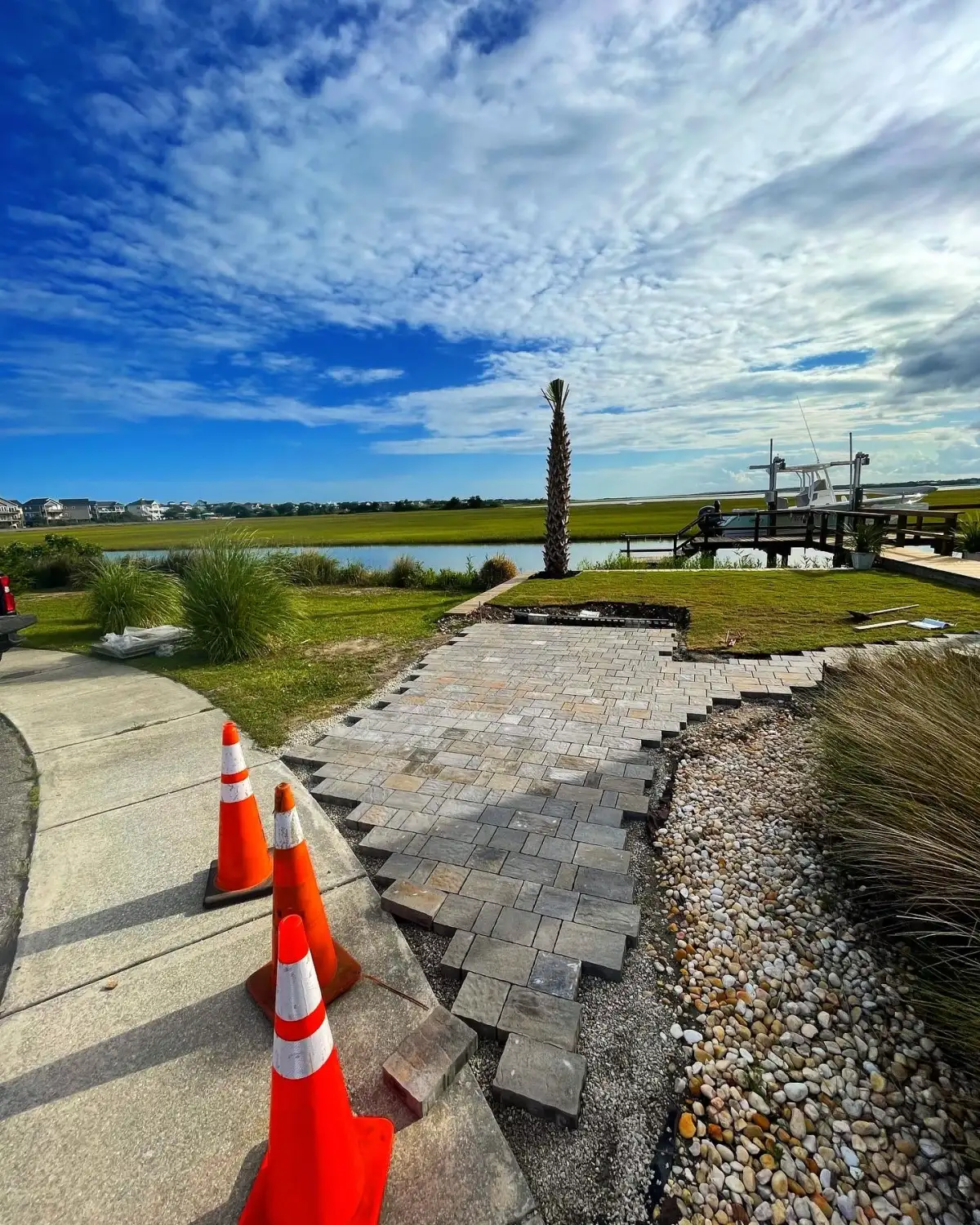
Every homeowner planning a patio in coastal North Carolina eventually runs into the same fork in the road: paver patio or poured concrete slab? The choice shapes the look of your backyard for the next two or three decades, the price you pay on day one, and the cost of repairs when the ground inevitably moves. We get asked this question during almost every Visionary Consultation. Here is the honest, practical answer from a design-build team that installs both.
The Short Version
For most luxury coastal NC homes, we recommend a paver patio built on a deep compacted base. Pavers handle settlement gracefully, tolerate coastal soil conditions better, look dramatically more upscale, and can be repaired piece by piece if something ever goes wrong. Concrete slabs are cheaper upfront but carry real long-term risks in our region, and when they fail, they fail in ways that are expensive and ugly to fix.
That said, there are situations where concrete is the right answer. Let's walk through both honestly.
The Case for Paver Patios in Coastal NC
Pavers are individual precast concrete, natural stone, or porcelain units set on a layered base of compacted stone, bedding sand, and polymeric joint sand. Each unit is independent. Each unit can move, flex, and be lifted and reset without affecting the rest of the patio.
Here is why that matters on coastal NC soils:
- Our soils shift. Coastal Pender, New Hanover, and Brunswick counties have mixed sand and clay profiles that expand and contract with moisture. Concrete slabs crack when they move. Paver patios flex and stay intact.
- Drainage is everything. Pavers drain between the joints. Concrete relies entirely on slope, which must be engineered perfectly and maintained over time.
- Repairs are easy. If a tree root lifts a section, we pull up the affected pavers, relevel the base, and reset them. You would never know the repair happened. On a concrete slab, that same repair is a saw cut and a visible patch.
- Aesthetics. Large-format pavers, color-blended patterns, and contrast border bands are standard on a paver patio and essentially impossible on a plain concrete slab. Stamped concrete tries to imitate the look and always reads as an imitation.
- Salt tolerance. Quality coastal-rated pavers are designed to handle salt air and freeze-thaw cycles. Concrete can spall under the same conditions if the mix is not carefully specified.
For most luxury homes in our service area, these advantages compound over time. A properly built paver patio from ENC Designs is engineered to look and perform the same in year fifteen as it did in year one. A typical concrete slab rarely makes it that far without visible cracking.
The Case for Concrete Slabs
Concrete is not a bad material. It is the right choice in specific situations:
- Tightest budget. A stamped or broom-finish concrete slab is generally the cheapest finished patio you can install.
- Utility spaces. A concrete pad for an HVAC unit, generator, or trash enclosure does not need the aesthetics of a paver patio.
- Specific architectural styles. Ultra-modern homes that intentionally want a monolithic concrete look can make a poured slab work as a design element.
- Short-term ownership. If you are selling in two years, a concrete slab may be the faster, cheaper fix.
If any of those apply, a thoughtfully poured and reinforced concrete slab is a legitimate choice. We will tell you that during a consultation, and we can point you toward a reputable concrete contractor if it is outside our typical scope.
Cost Comparison
Let's compare realistic 2026 cost ranges in coastal NC for a 400 square foot backyard patio installed professionally:
- Broom-finish concrete slab: Approximately $12 to $18 per square foot. Lowest upfront cost.
- Stamped/colored concrete: Approximately $18 to $28 per square foot. Mid-range upfront.
- Standard paver patio: Approximately $22 to $35 per square foot. Includes deep compacted base, bedding sand, polymeric joint sand, and edge restraint.
- Premium paver patio (large-format, border bands, natural stone, or porcelain): Approximately $32 to $55+ per square foot.
At the low end, concrete is roughly half the upfront price of a standard paver patio. At the high end, the gap narrows quickly. And when you factor in lifetime cost — not just upfront, but repair and replacement over 20 years — pavers usually come out ahead because repairs are cheap and replacement is rare.
What Happens When Something Goes Wrong
This is the part nobody discusses at the free estimate stage, and it matters more than almost any other factor.
Concrete slab failure modes: hairline cracks that grow. Major cracks from slab curl and shrinkage. Settlement cracks along edges. Pop-outs from freeze-thaw in cold snaps. Discoloration. Spalling. Stamped color wearing off. None of these are easily repaired. The standard fix is a saw cut and patch, which is visible forever, or a complete tear-out and re-pour.
Paver patio failure modes: settlement in a specific area (lifted and reset without replacement). Joint sand loss (reapplied with polymeric sand). Edge movement (re-secured with edge restraint). All of these are cheap, quick repairs performed on the specific area. The rest of the patio is untouched. Over a 20-year lifetime, maintenance cost on a quality paver patio is a small fraction of replacement cost on a failed concrete slab.
Base Construction Matters More Than Material
Here is the hidden truth most contractors will not tell you: both materials succeed or fail based on the base underneath. A paver patio installed on a shallow, poorly compacted base will fail just as badly as a concrete slab on the same base. The difference is that when the paver patio fails, you can fix it — and when the slab fails, you cannot.
Every paver patio from ENC Designs is built on a minimum 6-inch compacted aggregate base for residential patios, with deeper base for heavy-use zones, driveways, and areas with soft underlying soils. This is the unsexy, underground work that nobody sees and everybody benefits from for the next 25 years. Cutting base depth is the single most common cost-cutting move we see from lower-tier contractors, and it is the single most common reason patios fail.
Aesthetics and Resale Value
Luxury homes in Wilmington, Smithfield, Carolina Beach, and Surf City are held to a different visual standard than suburban tract homes. Pavers deliver a distinctly upscale aesthetic — color blends, border bands, integrated seat walls, and pattern detail — that a concrete slab simply cannot match. For high-end homes, pavers also contribute positively to resale value in a way that plain concrete does not.
If you have invested in a beautiful home, invested in beautiful interior finishes, and invested in a curated landscape, the patio is not the place to save fifteen cents on the dollar by pouring a slab.
Our Recommendation
For luxury outdoor living in coastal NC, we recommend paver patios to almost every client. They are more durable, more beautiful, more repairable, and a better long-term investment. If your budget is tight, we will help you right-size the scope — a slightly smaller, well-built paver patio is a better long-term value than a larger, cheaper concrete slab.
And no matter which you choose, insist on deep base construction, proper drainage, and professional installation. Those three things separate a patio that still looks great in twenty years from one that becomes a repair project in five.
Ready to Plan Your Patio?
If you are weighing your options for a patio in Wilmington, Smithfield, Carolina Beach, Surf City, Hampstead, Wallace, or Leland, we would love to help you make the right call for your specific property. Every consultation includes an on-site evaluation of your terrain, soils, drainage, and sightlines, plus a transparent conversation about cost and materials.
Book your Visionary Consultation, call (919) 634-2359, or browse completed paver projects in our portfolio gallery.